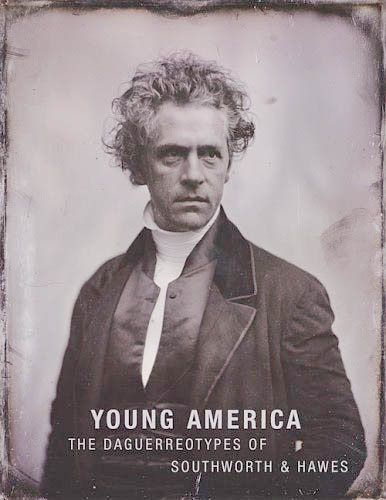
YOUNG AMERICA – The Definitive Book about the daguerreotypes of Southworth and Hawes — American Museum of Photography – book review – sale price


|
“All lovers of the daguerreotype are spellbound beings” wrote photography curator Grant Romer, in one of the most memorable (and most apt) book-jacket blurbs of all time. A thousand such spellbound people belong to The Daguerreian Society, an international group devoted to the history, art and practice of the daguerreotype process– the first practical method for making photographs. Daguerreotypes have extreme depth and detail, together with an elusive, glittering, mirror-like quality that shifts between negative and positive images. For some people, seeing just one is enough to get addicted. Of the thousands of daguerreotype studios that opened in the United States between 1840 and the late 1850s, the firm of Southworth & Hawes of Boston is best known today. In some measure, this is due to the partnership’s practice of making extra images at many sittings, so that one or more plates could be kept on file at the studio. The result was an archive of documented plates, numbering in the thousands. This archive survived largely intact until the early 20th century, when it was dispersed. (In fact, the dispersal was not really completed until an auction in 1999.) Only a couple of similar archives have survived, notably the cache of 600 daguerreotypes by Thomas Easterly, now at the Missouri Historical Society. Southworth & Hawes are important for more than just keeping a hoard of their work intact. They were technical innovators and they were among the first photographers to consider themselves artists. Just how they injected artistry into their work is best understood by seeing a large body of their images. And while their archive has been physically dispersed, a multi-year project by the International Center of Photography in New York and George Eastman House of Rochester, N.Y. has succeeded at putting Humpty Dumpty back together again — reuniting nearly 2,000 documented Southworth & Hawes daguerreotypes in the 550 pages of Young America: The Daguerreotypes of Southworth & Hawes. |
||
|
||
|
Young America was published in conjunction with an exhibition of original Southworth & Hawes daguerreotypes, shown June 17–September 4, 2005 at the International Center of Photography in New York, October 1, 2005 – January 8, 2006 at George Eastman House in Rochester, NY and January 28 – April 2, 2006 at the Addison Gallery of American Art in Amherst, Massachusetts. The book was edited by the curators of the exhibition, Brian Wallis of ICP and Grant “Spellbound Being” Romer of Eastman House. Romer’s essay quotes a daguerreotypist, N. G. Burgess, who predicted in the 1850s that some day, daguerreotypes would be highly valued: “In after ages, when these images on the silver plate have become an olden theme like the sublime creations of the painters’ skill of a former age, then indeed their true value will be known and appreciated.” Romer observes, “We have come to that time.”
|