 |
- Clarence H. White (1871 -1925)
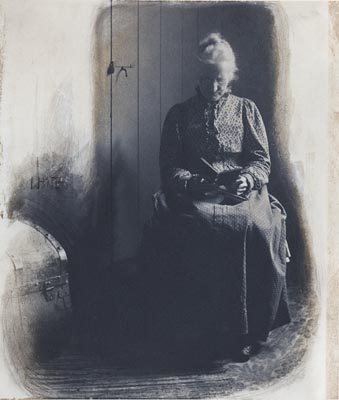
- The Old Hester Tyler That I Knew
- Platinum print (glycerine-developed), approximately 6.8 x 8 inches, 1903/1904
White planned this image as the last illustration for the short story “Beneath the Wrinkle” and included it in the portfolio he submitted to McClure’s magazine. It depicts an elderly woman in an attic room, beside a trunk containing her few possessions, gazing at a daguerreotype portrait of her murdered lover.
This image was omitted when McClure’s published “Beneath the Wrinkle” illustrated by White in 1904.
|
|
|
In early 2006, more than a century after “Beneath the Wrinkle” appeared in McClure’s and nearly 30 years after the portfolio of White’s illustrations was rediscovered, another image surfaced. Offered at an online auction without attribution, this photograph is a platinum print that appears to be on the same rough-textured paper as one of the prints in the original White portfolio.
The seller of the photograph could not recall where it was obtained, although two other pictorialist images (prints removed from 1902 issues of the journal Camera Notes) were found along with it..
In the newly-discovered photograph, the “hair-trunk” is missing but a chest of drawers is present. The woman portraying Hester is again gazing into an opened daguerreotype case. A candle and a book (most likely representing the small Bible described in the story) can be seen on top of the chest.
On close examination, pencil or crayon lines can be seen on the surface of the print, most evidently on the rug and the woman’s dress. This hand work is consistent with other Clarence H. White prints from the same period.
|
|
|
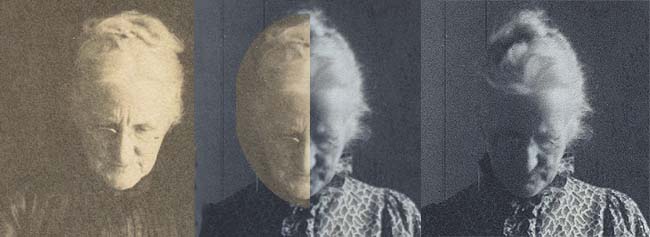 |
A comparison of the faces in the two photographs leaves little doubt that the same model appears in both of them. The clothing is different, and there seems to be some variation in the hairstyle, suggesting the two images may have been taken at different times.
|
|
|
The commission from McClure’s was a major step in the career of Clarence H. White. The publication of his illustrations to “Beneath the Wrinkle” promised national exposure for his work and encouraged him to leave his job as a bookkeeper in Newark, Ohio to pursue photography as his profession. For such an important project, it is likely that White made more than a single attempt at some of the photographs. What is interesting about the two variations on “The Old Hester Tyler That I Knew” is that both appear to be finished works and that the newly-discovered version is arguably more successful at conveying the emotion of the story’s final scene.
|
|
|
|
Perhaps adding to the mystery is this concluding comment from a 1900 review of White’s work in The Photographic Times by the critic Sadakichi Hartmann:
I am doubtful about his “Old Chest Studies.” They have been accused of being theatrical. I do not agree there; they have sprung from genuine feeling, and show how far Mr. White’s imagination may venture successfully. They are like scenes illustrating some strange story of people of bygone days moved by some heart-rending sorrow or feverish desire. A lurid light hovers over these quaintly draped women who bend over an old chest and clasp in their pale hands some relic, a sword or a chain, with the ardor of some deep emotion called up from the graves of the past. They have a great fascination for me, and yet I do not believe they would remain longer than two weeks on my wall. A story has to be marvelously well told to be permissible in pictorial art, and the “Old Chest Studies” do not reach, despite their merits, that state of perfection; they are, after all, only studies. But they, like two-thirds of his exhibited prints, should find a place in the portfolio of every collector of artistic photographs.
Could it be that White’s “studies” (exhibited in New York in 1899) were part of his grand experiment in the use of photography as illustration? Hartmann’s comments could apply to even the most successful illustrative works, which rely on interaction with a text to achieve the “state of perfection”– to fully tell their story. The images in the faded purple portfolio seem to illustrate that point — just as they illustrate the words of Clara Morris’s story. |
|