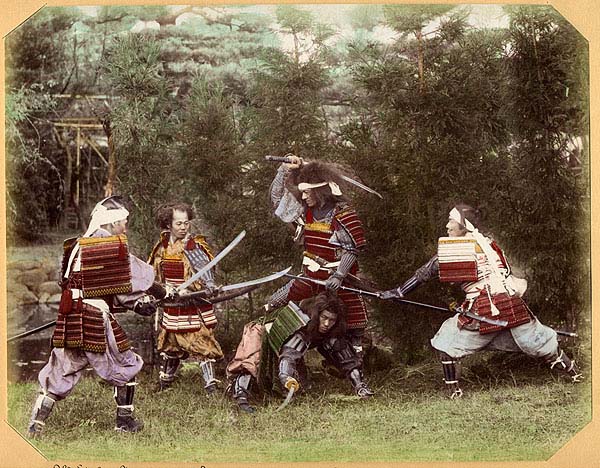
| Kazuma Ogawa (1860-1928)
“Old-Style Armor”
Tinted albumen print, circa 1880
A note in period ink on the mount holding this photograph observes that the armor shown is now used only for theatrical performances. The privileged samurai class was abolished– after almost a thousand years– when Emperor Meiji ended the feudal system by edict in 1871. Five years later, another imperial edict eliminated the right to carry swords. Isolated rebellions followed as some samurai fought the modernization of Japanese society and the reforms ordered by the Emperor. This photograph, however, could not refer to the rebellions as it shows samurai fighting one another and not battling the Japanese army.
Because exposure times of several seconds were usually required during this period, Ogawa’s photograph could only have been made by carefully posing his subjects. Despite this, the image is convincing in its depiction of arrested action.
Kazuma Ogawa learned about photography from a British missionary in Tokyo in 1873. After an apprenticeship he opened his first studio in 1877. Ogawa left for the United States in 1882, becoming the first Japanese photographer to study abroad. After working in Boston and Philadelphia, he returned to open a studio in Tokyo in 1885. Ogawa brought with him knowledge of the collotype process, which he used for publishing illustrated books. He also learned about the manufacture of photographic dry plate negatives– a business he entered shortly after his return to Japan. Ogawa’s other accomplishments included editing Japan’s first photographic journal, co-founding the Japan Photographic Society, and becoming the first Japanese citizen to be named a Fellow of the Royal Photographic Society of Great Britain.
|