 |
Who first claimed “the camera does not lie?” The origins of that old bromide are obscure, but by 1859 – twenty years after the invention of photography – a similar phrase was used in a drama by the American actor and playwright Dion Boucicault.
|
In The Octoroon, an unattended camera magically takes and self-develops a photograph that reveals the identity of a child-killer and stops the lynching of a falsely-accused Native American:
Samuel Scudder. A photographic plate. (Pete holds lantern up.) What’ s this, eh? Two forms! The child–’tis he! Dead–and above him–Ah! ah! Jacob M’Closky, ’twas you murdered that boy!
M’Closky. Me?
Scudder. You! You slew him with that tomahawk; and as you stood over his body with the letter in your hand, you thought that no witness saw the deed, that no eye was on you–but there was, Jacob M’Closky, there was. The eye of the Eternal was on you–the blessed sun in heaven, that, looking down, struck upon this plate the image of the deed. Here you are, in the very attitude of your crime!
M’Closky. ‘Tis false!
Scudder. ‘Tis true! The apparatus can’t lie. Look there, jurymen. (Shows plate to jury.) Look there. Oh, you wanted evidence–you called for proof–Heaven has answered and convicted you.
The idea that photographs embody a perfect form of truth – perhaps even a divine form of truth – gained currency during the first months following the public announcement of photography by Louis J. M. Daguerre. In a valiant effort to explain photographs to a readership that had never seen any, journalists often compared the earliest camera images (called “daguerreotypes”) to paintings. Edgar Allan Poe reported
. in truth, the Daguerreotyped plate is infinitely (we use the term advisedly) is infinitely more accurate in its representation than any painting by human hands. If we examine a work of ordinary art, by means of a powerful microscope, all traces of resemblance to nature will disappear – but the closest scrutiny of the photogenic drawing discloses only a more absolute truth, a more perfect identity of aspect with the thing represented. The variations of shade, and the gradations of both linear and aerial perspective are those of truth itself in the supremeness of its perfection.
Even before the details of Daguerre’s process became known, writers were speculating on the implications of photography’s ability to record the literal truth. In April of 1839 The New Yorker asked, “What would you say to looking in the mirror and having the image fastened!! As one looks sometimes, it is really quite frightful to think of it; but such a thing is possible – nay, it is probable – no, it is certain. What will become of the poor thieves, when they shall see handed in as evidence against them their own portraits, taken by the room in which they stole, and in the very act of stealing! What wonderful discoveries is this wonderful discovery destined to discover!”
It would be many decades before the crime-fighting properties of photography envisioned by The New Yorker (and later by Dion Boucicault) would become technically feasible. However, photographs would soon be fighting crime in other ways — as courtroom evidence. In that capacity, the medium’s claims to being unerring and perfect in its truthfulness would become highly controversial.
“The camera does not lie” is a corollary to a concept that predates photography: “Seeing is believing.” The origins of this expression are also obscure, but two thousand years ago the Roman poet Horace offered a similar sentiment in his letter on The Art of Poetry :
- What we hear,
- With weaker passion will affect the heart,
- Than when the faithful eye beholds the part.
- (Segnius irritant animos demissa per aures,
- Quam quæ sunt oculis subjecta fidelibus.)
If “seeing is believing” and “the camera does not lie” are both perfectly accurate, it would follow that the camera should be the most faithful witness possible. Even so, judges in the United States and Britain spent years wrestling with the admissibility of photographs as evidence.
With the possible exception of nihilistic experiments performed in the name of Art, every photograph is taken for a purpose. Most often, that purpose is the creation of documentation. When photography was brand-new, people rushed to daguerreotype galleries to have family portraits made, documenting appearances (and, indirectly, relationships.) Within a few years, photography was being utilized to document events of international importance, such as the California Gold Rush or the Crimean War. By the time of the U.S. Civil War, which was recorded by teams of photographers in the employ of Mathew Brady and others, photojournalism was an established practice.
The public accepted photographs as literal truth, and so did the courts– for purposes of identification and the comparison of handwriting. One scholar, writing in The American Law Register in 1869 noted
We know that the photograph is not the work, in any respect affecting its truthfulness, of a human brain, but of natural forces, which, experience teaches, generally speak the truth without flattery or detraction. If I am correct in this, a photograph, proved to be that of a person absent is that person himself, precisely as he exists in the article of vision-is, therefore, direct and original evidence of the kind of man he was. So, of the photographic likeness of any natural object or place.
Photographers, however, knew better. They understood that their art was not always unimpeachable, and that the choice of lens, camera angle, even the time of day that a picture was made could all have an impact on the final image. One such case in 1886 involved a dispute between two persons about a wall. The plaintiff charged his neighbor’s wall was too high and obstructed the sunlight. The judge seemed to be swayed by a photograph showing the wall to be immense and casting a dark and gloomy curtain of shadow, as charged. But then the defendant’s lawyer, with a smile, handed the judge a photograph of the same scene. This time, the judge was confronted with a picture that seemed to show a tiny, insignificant wall that could not possibly cause any harm. Both law journals and the photographic press noted this case. The Photographic News acidly reported how one of the attorneys discovered from a colleague that photographs could be skewed to present a particular perspective: “In a close conversation of some fifteen minutes, which followed, the solicitor learned what he did not know before, he learned that the photograph may be made to speak for this or for that, according as the finger of mammon does point.”
If the purity of photographic truth could be so easily corrupted, what of the ancient claim that “seeing is believing”?
In the 1890s a new school of thought emerged in the field of Psychology. Called “Gestalt,” its adherents studied the mechanisms of perception through optical illusions. These simple diagrams and drawings provide a window into the workings of the mind; we may know that the horizontal lines in a diagram are straight, because we’ve just investigated with a ruler, but our minds insist on perceiving the lines as curved.
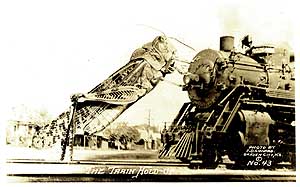
Optical illusions teach an important lesson, because they convincingly demonstrate that seeing isn’t always believing. And in the same way, manipulated “trick photographs” provide incontrovertible proof that the camera can be taught to lie. We find many of these images compelling for the same reasons that we can watch a good magician perform the same act many times over: the magician uses his talent to momentarily convince us of things we know are impossible– and so do the best trick photographs. The source of our fascination is the experience of having our own brains fall victim to what we know to be an illusion. We fool ourselves, delight in our own gullibility, and marvel at the magic.
Wm. B. Becker