1870 and 1871 were years of devastating political turmoil and civil war in Paris. Trouble began when Emperor Napoleon III declared war on Prussia in July of 1870. A month later, German troops crossed into French territory; a month after that, the Germans captured Napoleon III and 100,000 of his troops.
With the Prussian forces laying siege to Paris, two rival governments proceeded to battle for control of France: a faction led by Louis-Adolphe Thiers that signed a peace treaty with the Germans, and a radical group that controlled the city of Paris, known as the Paris Commune. The Communards opposed the National Government of Thiers for being too loyal to Napoleon III, too conservative, and too willing to pay reparations to the Germans. When the second siege of Paris began in the Spring of 1871, it was French troops loyal to the Thiers government who were fighting French opponents holed up inside the city. The five-week siege and the reprisals that followed left many landmark buildings in ruins and tens of thousands dead.
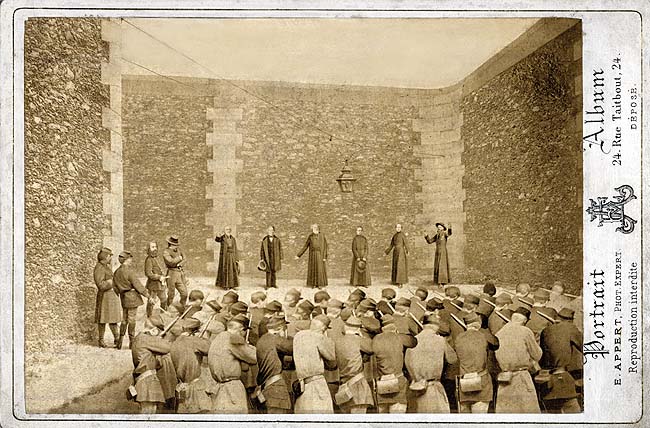
The desperate acts of the Communards in the final days of the siege included executions of hostages. The event shown took place at la Roquette prison on May 24, 1871. With four leaders of the Commune giving the orders, troops shot the Archbishop of Paris, Monsignor Darboy; Abbe Deguerry; three Jesuit priests; and Judge Bonjean, President of the Paris Court of Appeals. Another photocollage with the same background shows prison employees collecting the bodies.
It is difficult to tell with certainty whether any portions of this picture were made from actual photographs rather than being drawn or painted, although it seems likely that the faces of the victims would have had photographic origins. Because the finished product is made on photographic paper, and mounted in the standard format used for photographic portraits and views, the public would have accepted this reconstruction as if it were an actual documentary photo of this bloody event.
The photographer Eugene Appert made a series of pictures showing similar atrocities — but only those committed by the forces of the Commune and not the bloody reprisals of the ultimate victors, the national troops loyal to Thiers. Perhaps if the fighting had gone the other way, Appert would have featured the crimes of the national forces against the Communards.