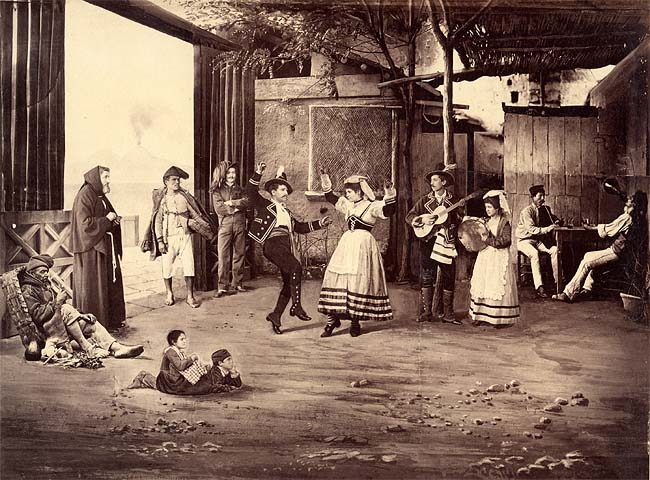
The Tarantella is a folk dance that originated hundreds of years ago. Tradition has it that in the 15th to 17th centuries a wave of tarantism, a form of melancholy thought to be caused by the bite of a tarantula, swept a city in southeastern Italy. The only treatment was to engage the victim in energetic dancing to a particular melody until the symptoms subsided.
This photographic creation incorporates a number of Sommer’s studies of the picturesque “types” found on the streets of 19th century Naples. At the far left, the pipe-smoking man sitting in a basket is a “lazzarone” or tramp. The man in uniform next to the far door-frame is a “Bersagliero,” a member of a military unit known for their plumed hats. The wine-drinkers– and presumably the other figures as well–could all be purchased as separate photographs. Vesuvius, which is billowing smoke in the distance, was also a frequent subject for Giorgio Sommer.
It is difficult to know the precise techniques used to create this picture–it may combine photomontage (in which sections of several images are printed together onto the same piece of photographic paper) with photocollage, where pieces of several photographs are cut out and pasted together. In any case, a great deal of touching up by an artist is evident, and the floor looks like it was entirely created with a paintbrush.
Certainly “The Tarantella” violates the stern dictum of Henry Peach Robinson, that “no departure from the truth of nature shall be discovered by the closest scrutiny.” It doesn’t take much scrutiny to see that the children sitting on the floor are gazing intently in the wrong direction, and they are out of proportion with the rest of the figures. The tramp also seems to be looking away from the frenzied dancers.
But none of this apparently bothered Sommer’s customers, as this image has survived in several formats and seems to have been a strong seller.