|
|
The original publication of “Beneath the Wrinkle” as it appeared in McClure’s magazine for February 1904:
|
|
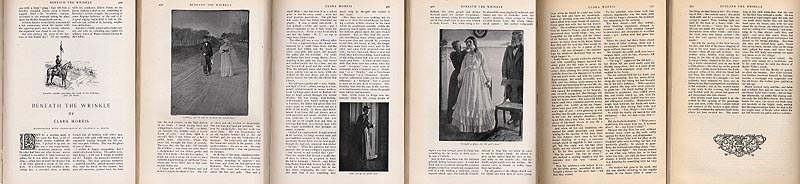
How did Clarence H. White’s original photographs translate to the printed page? Was his best work dropped by the editors of McClure’s who commissioned him? You can compare the originals to the magazine’s halftones (photographs printed in ink using a pattern of dots) and view the unpublished works below.
|
|
|
Original Print
|
Halftone Reproduction
|
|
|
|
|
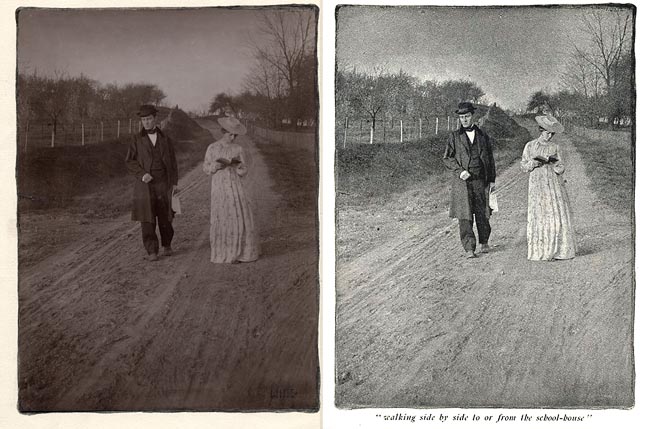
The original (far left) is a collodion print, made on a type of photographic paper seldom used by pictorialist photographers; it’s signed in black ink in the lower right.
Halftone reproduction of photographs was far from perfect in 1904. The printed version on the right seems to have been touched up to sharpen the details in the faces and in the man’s clothing. While the signature has been removed, White’s artistic ink borders have been preserved in the magazine version.
The model portraying Hester is Julia McCune, a family friend of the photographer.
|
White also included a signed and mounted platinum print of this image in the portfolio, perhaps as a gift to the editor.
|
|
Original Print
|
Halftone Reproduction
|
|
|

|
|
Although it is signed and mounted like the other images in the portfolio, this collodion print seems the least “finished” of all the illustrations. The ink border to the right appears to serve as a cropping mark, suggesting that White was unsure about the best way to present this image. The much more severe cropping used in the magazine’s version (right) changes the composition significantly, eliminating the window as the light source and also removing the dimly-lit lines of the wood siding by the door.
|
|
Original Print
|
Halftone Reproduction
|
|
|
|
|
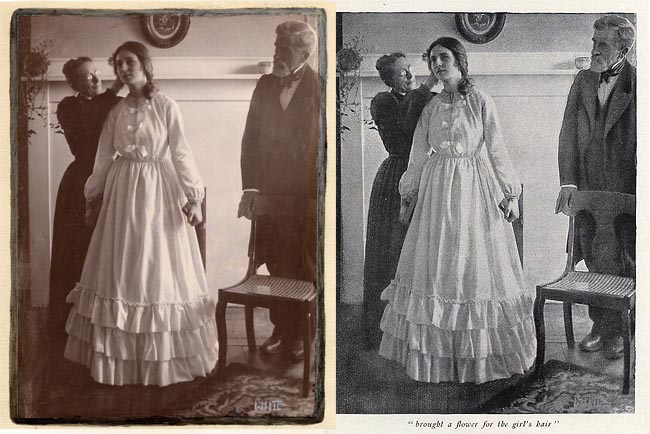
White’s mastery of light was one of his hallmarks, but the halftone process was not capable of conveying all of the subtleties of lighting in this image. The flattened tones on the right side of the original serve to keep our attention on the women but the halftone engraver has chosen to add details to the chair back and to the minister’s face and jacket, changing the overall effect.
White’s mother is the model for the minister’s wife. According to a recent message from a descendant, the minister is portrayed by William T. Evans (1832-1908), a Civil War veteran whose family attended the same church as White.
|
This is the best-known image from “Beneath the Wrinkle.” In 1905 it was republished in Alfred Stieglitz’s reknowned journal, Camera Work, and in La Revue de Photographie. A platinum print is in the collection of Alfred Stieglitz (The Metropolitan Museum of Art, New York.) The photograph was exhibited at the Photo-Secession Galleries in New York in 1906, and displayed at exhibitions in Hamburg (1903), Washington (the Corcoran Art Gallery, 1904), Dresden (1904 and 1909), The Hague (1904) and Vienna (1906.)
|
|
|
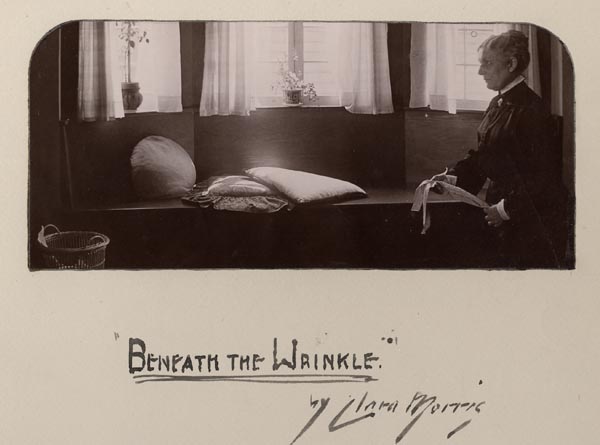
White’s title page image did not appear in the published version of the story. It is an especially deft composition, starting with the sort of homey setting and natural arrangement that made White famous. The photographer has added a pair of unsettling elements: the unorthodox placement of the story’s narrator at the far side of the frame, and an eerie glow that seems to rise from the cushions on the window seat.
The model is believed to be Mary Ann Jones Evans (1839 -1921), according to recent correspondence from a descendant. Mrs. Evans was the wife of William T. Evans, who portrays the minister in “brought a flower for the girl’s hair.”
The title page image is a collodion print with ink border, mounted on board with the story title and author’s name added in ink.
|
|
|

|
The fifth of six images in the portfolio, this collodion print was not published in McClure’s. White has added the usual ink border and signed his name in black ink (lower right) but unlike all of the other images in the portfolio, the mount of this print has no quotation from the story signifying its place in the text.
There is no doubt, however, that this elegantly spare photograph illustrates the dramatic climax of the story:
Her brother had gone to his work, and she was silently attending to her regular duties in the house when it came! – the thing she had listened for! The tramping of feet-the excited voices! She stood stock-still, and for a moment felt that she swung in space! Then, holding tight and hard to the back of a heavy chair, she heard the words–“Carry him in here till you can mend the wagon” –separate themselves from other words; and knew the front door was being opened–the door that only opened for marriages and deaths!
|
|
-
|

|
The final image in the portfolio was also omitted from the published story. It appears to be a glycerine-developed platinum print, made using a technique that allowed the photographer to control the production of the finished photograph using brush strokes.
For this illustration, White has taken some liberties with the descriptions in the story. The narrative suggests that the “hair trunk” is covered in horse hide and has Hester’s initials in large brass nails on the top. In addition, Hester is clearly described as kneeling beside the open trunk as she looks at the daguerreotype of her lost love.
White has signed his name in a shadowy area of the wall behind the trunk. The photograph is mounted, titled, and consistent with many of White’s exhibition prints.
Although this is the last illustration in the portfolio, it is not the final word from Clarence H. White on “Beneath the Wrinkle.”
A surprising discovery… next.
|
|
|
Next:  The Two Hesters The Two Hesters
Click above for the final page of this exhibition. Or click here for the American Museum of Photography’s Home Page
|
|